
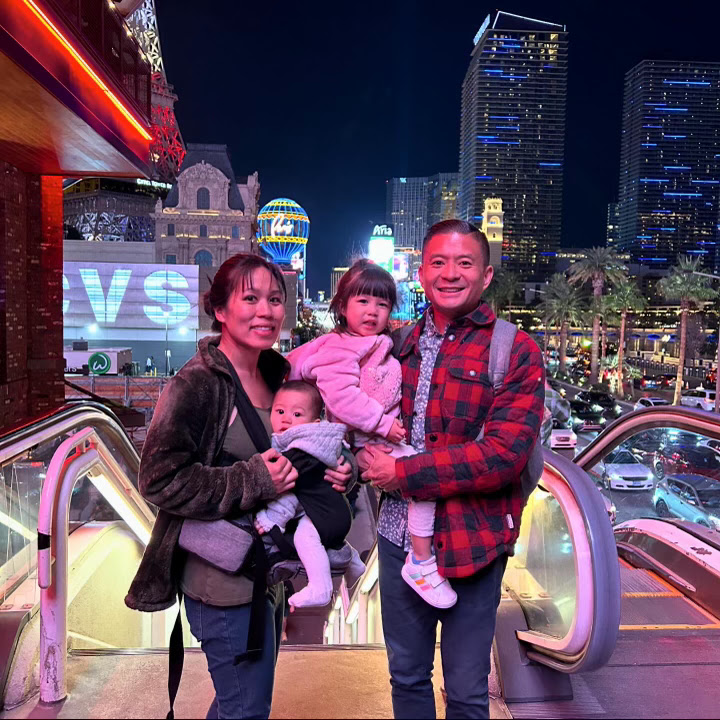
I used to be the kind of traveler who made it her mission to see everything—packed schedules, must-see spots, all the best places to eat.
Then I had kids.
Now? If we make it to lunch and nap without someone crying, I call that a win.
Planning a family trip with little kids can feel like a logistical nightmare, but it doesn’t have to suck the joy out of travel. These are my favorite practical that make family trips less chaotic and way more fun.
We’ve taken our kids (4 and 2) on 14 road trips and 24+ flights (yep, even internationally), and I’ve learned what actually works, and what just sounds good on paper.
This post will show you how to plan a family vacation that everyone will actually enjoy. Yes, even if you’ve got a nap-skipping toddler and a baby who hates the car seat.
Let’s plan a trip that feels more fun, and less like survival mode.
Tips for Planning a Family Vacation With Little Kids
1. Stay longer in fewer places


Before kids, we crammed our trips full of hikes, late-night food runs, must-see sights, and spontaneous detours. I once booked four cities in different European countries in ten days and thought I was thriving.
Then came our first international trip as a family.
Picture this: I’m pregnant, racing down a train platform in Belgium with a 2.5-year-old toddler, a croissant in one hand, and a train ticket in the other. We were dragging our bags to our fifth city in two weeks, and it hit me like a freight train.
We were doing too much.
Every travel day became a lost day. We’d pack, bribe our toddler into clothes, stress about trains, check into the next place, and collapse. No energy left to explore. No fun. Just… survival.
That was my wake-up call.
Now, we stay in fewer places for longer. We unpack. We settle in. We find a neighborhood café.
💡 Why this helps: You avoid losing a full day to packing and transit and actually get to enjoy where you are.
2. Choose your home base wisely


Before kids, I booked whatever was budget-friendly, even if it meant a longer commute or less comfort. Now that I’m paying for more people and managing more logistics, I still care about cost… but I’m way more willing to pay for convenience.
We’ve learned the hard way that location and setup matter a lot when you have little kids.
Now, we look for places that make our lives easier. It doesn’t have to be fancy, just functional. If it saves us time, tantrums, or extra effort, it’s worth the extra $30 a night.
Here’s what we try to find:
- Close to the action: Ideally less than 20 minutes from the things we want to see and do The less time we spend loading and unloading kids from car seats, the better. Especially when it turns into a full-body wrestling match just to buckle them in
- Nearby to food: So we can be flexible with meals, even when someone’s melting down
- A playground or pool nearby: For that built-in energy burn when everyone’s restless
- A breakfast buffet: If I can get them a carb, a protein, a fruit, and maybe a veggie before 9 a.m., I feel like a supermom
- A fridge or kitchen: Leftovers, snacks, bottles, drinks — having a fridge makes everything easier
I don’t always get all of these, but when we do, our days go way smoother.
💡 Why this helps: Being close to food, attractions, and a place to rest minimizes meltdowns and makes every day run smoother.
3. Plan by location, not a long checklist


I’m going to be honest. I don’t love planning. I love traveling, I love seeing new places, I love eating good food. But detailed day-by-day itineraries? Not really my thing.
Most of the time, I don’t even figure out what we’re doing until the night before.
But what has helped me the most is planning by location, not by squeezing in a long list of “must-sees.”
I use Wanderlog (free app) to save places I want to check out like restaurants, activities, playgrounds, and more. Then I drop them on the map and group nearby spots together as a mini “outing zone” for the day.
That way, we’re not zig-zagging all over town. With kids, that’s way too much. Honestly, just getting them into the car seat can be a whole production.
💡 Why this helps: Grouping nearby activities cuts down on car time and makes your day feel doable with little kids.
4. Plan less in a day


But it wasn’t just the city-hopping that wore us out. Even after we slowed our travel pace, we were still trying to do too much each day.
We’d cram in museums, restaurants, cute neighborhoods, and playgrounds — thinking we could squeeze it all in between naps and snacks.
Spoiler: we couldn’t.
Now, we aim for just one or two things a day. That’s it.
Instead of planning every hour, we try to fit in:
- A local experience that gives us a feel for the place: This could be a walk through a cute neighborhood, a beach morning, a farmers market, a park, a short hike, or a small local attraction. Bonus if doubles as a meal stop, like a food hall or a lively plaza that has restaurants.
- A kid-friendly stop where they can run wild: A playground, splash pad, children’s museum, pool, zoo
- A casual meal: I usually check Google or Yelp reviews ahead of time — if we’re paying to eat out, I want the food to actually be good. Now, we go for places that are casual and loud-kid-friendly: food halls, breweries with outdoor space, or restaurants with fast service and high chairs. Sometimes, we even buy takeout and bring it to a park or playground.
- Something for us: And if I can sneak in a local coffee stop or Bryan finds a brewery nearby, even better.
Everything else? We let go of.
The less we plan, the more we enjoy.
Because when you’re not rushing between activities, you’re actually in the vacation:
- eating gelato in the shade
- watching your kid splash in a fountain
- taking a slow walk together after dinner
One of my favorite memories from Paris wasn’t the Eiffel Tower or the museums. It was sitting on a picnic blanket with my 2.5-year-old, eating grocery store baguette, salami, and cheese while Bryan played a French song on Spotify. That’s it. But it felt like magic.
💡 Why this helps: Fewer plans means less stress, more flexibility, and more space for spontaneous fun.
5. Include a kid-friendly stop most days (Think Playgrounds)


We don’t schedule something big for the kids every single day, but most days, we make space for them to move, explore, and just be kids.
That could mean:
- A playground where they can run simply play and be wild without us constantly saying “no” or “watch out”
- A children’s museum or science center where they can touch, play, and experiment
- A hotel pool or beach if we want something lower effort but still active
Hands-on children’s museums, science centers, and playgrounds keep kids engaged and burn energy.
Some of my favorite moments are when my kids later connect the dots to something she saw on our trip. It’s this little reminder that they’re learning and remembering, even if it doesn’t look like a “lesson” in the moment.
💡 Why this helps: Burnoff time gives kids a chance to move and reset, and makes them way more chill and agreeable to everything else.
6. Make space for downtime


We used to treat “free time” like a gap that needed filling. Now it’s something we intentionally plan for.
That awkward window between lunch and dinner? It’s our reset time.
Some days, we head back to the hotel:
- rest
- screen time
- snacks
- pool
No shame.
Other days, we hide out from the heat in a coffee shop with AC while the kids get drunk on fruit smoothies.
And when the kids still have energy but we don’t, it’s pool time or playground time.
That mid-afternoon window is gold. Not just for them, but for us too. It gives everyone a second wind to enjoy the evening instead of crashing hard or spiraling into meltdowns.
I’ve learned that if we go hard one day (like a full-on theme park day from morning until night), we need to go easy the next.
And honestly, some of our best memories have come from those slow, nothing-special afternoons where we just let ourselves be.
💡 Why this helps: Everyone gets a second wind to enjoy the evening instead of crashing into meltdowns.
7. Take turns for solo time (and sanity)


One of the best ways we keep family trips feeling balanced is by taking shifts.
One parent watches both kids while the other sneaks off for a little freedom:
- My solo time might be a massage, a coffee shop, browsing local stores, or taking pictures for my blog
- Bryan’s might be a local brewery, casino, or gym workout
What works well:
- Playgrounds, indoor or outdoor, where one parent can hang with both kids
- We stayed at a few hotels in Vietnam that had kid play areas, and it made things so much easier
In Vietnam, we also found pickleball courts in three of the four cities we visited. We played doubles with friends and took turns. One parent played while the other colored or played tag with the kids in the spectator area nearby.
Bonus: If you’re traveling with friends who love kids, they might jump in and play while both parents get a break. Those little pockets of freedom help everyone feel more human on the trip.
💡 Why this helps: A small break can recharge you completely and make the trip feel less like nonstop parenting.
8. Bring your village (or make one)


You don’t have to do it all alone. If you have the option to travel with help, take it.
Traveling with grandparents or another trusted adult? Huge win.
On a trip to Las Vegas, my mother-in-law came with us and watched the kids one night so Bryan and I could go out for a proper date. We had dinner, dessert, and actual adult conversation. It was only a couple hours, but it felt like a full reset.
Traveling with another family with kids? Also amazing.
We’ve done this in Big Bear, Palm Springs, San Diego, and Las Vegas, and it makes everything better.
- The kids entertain each other
- Parents can vent about kids and chaos together
- You can tag-team supervision
- Other parents bring snacks your kids will actually eat
- You’re not the only one handling sunscreen, bandaids, or tantrums
It’s more chaotic in some ways, but also way more fun.
That said, if you’re traveling with another family, make sure the kids actually get along before you go. Nothing makes a trip feel longer than constant bickering or mismatched expectations.
You don’t have to be together all day, but even a few shared outings or dinners can take the pressure off and make it feel less like work.
💡 Why this helps: A small break can recharge you completely and make the trip feel less like nonstop parenting.
9. Pack a few “just in case” tools

Even with the best laid plans, there will be moments on your trip when you just need your kid to cooperate. Fast.
That’s why I always pack a few low-effort “tools” (you might know it as “candy”) that I can pull out in a pinch:
- lollipops
- gummy bears
- M&Ms
- Pockys
- Fruit snacks
- whatever snacks your kid lights up for
These aren’t everyday snacks in our house, so they feel like a big deal when they come out. I don’t use them often, but when I do, they work.
I remember one short hike where my 4-year-old was staging a full protest before we even started. She plopped herself down on a rock and flat-out refused to move. I didn’t have any magical parenting strategy. I just said, “There’s a fruit popsicle waiting at home if you can walk the whole way to the end without being carried.”
Suddenly, she had the energy of a mountain goat and marched the whole trail herself.
Not my proudest parenting moment, but it saved the day. And now I always keep a stash in my bag on travel days, just in case.
💡 Why this helps: A well-timed snack or bribe can turn a meltdown into a memory and save the day fast.
10. Hype them up


Little kids don’t understand “next month” or “three more days” the way we do. But they do get excited about one specific thing, especially if you show them a picture or video of it ahead of time.
Before our trip to Vietnam, I showed my kids an Instagram reel of a ball pit restaurant in Phan Rang. My older one couldn’t stop talking about it. Every time travel got hard, she’d say, “Are we almost at the ball pit?”
Our 26-hour travel day included two layovers, three airports, a long flight, and an hour drive. That one tiny moment of excitement helped carry her through all of it.
You can do this with any trip:
- Show them photos of family or friends they’ll see, especially if there are other kids
- Find a video of a kid-friendly spot like a playground, ball pit, splash pad, children’s museum, or zoo
- Talk about what kind of snacks or treats you might try together, even if it’s just yogurt, ice cream, or croissants
- Let them pick one thing they’re excited for
It makes the whole thing feel more like an adventure and less like grown-ups dragging them somewhere.
💡 Why this helps: Getting kids excited about one thing ahead of time helps them power through long travel days.
11. Roll with the chaos


No matter how well you plan, something will go sideways. Someone will refuse to nap, spill an entire smoothie on themselves, or lose their mind over the “wrong” color spoon. It’s not about if chaos happens, it’s about how you handle it.
On a recent cruise, my toddler had a full-on meltdown in our cabin because he wanted “Daddy do it,” meaning Bryan had to be the one to put on his shoes. But Bryan had already left the room.
For what felt like ten straight minutes, he screamed. Refused help. Refused comfort. Just completely lost it.
So I shoved the shoes in my pocket, hoisted him over my shoulder like a sack of potatoes, and walked out the door. He was still yelling as we made our way to the common area.
Then he stopped.
The change in environment was enough to reset everything. He looked around, saw something new, and completely forgot the shoes even mattered.
Your trip doesn’t have to be perfect to be memorable. Let go of the plan when it’s not working. Choose your battles.
And remember, toddler chaos is part of the deal, not a sign you’re doing it wrong.
💡 Why this helps: Flexibility makes tough moments easier, and often the best memories (or the ones worth re-telling) come from the unexpected.
👉 Tips for traveling with toddlers
👉 How to handle toddler tantrums while traveling
Tools That Make Planning a Family Trip With Kids Easier
You don’t need a fancy spreadsheet or expensive app to make this work. But you do need a way to organize the chaos.
Here’s what we actually use when planning family trips:
- Wanderlog: We drop pins for everything we might want to do like restaurants, playgrounds, activities, and lodging, and then group stops by location clusters to figure out what is reasonable to do together, and what the commute time would be between place to place.
- Booking.com and Airbnb: We tend to book hotels for amenities and location, and Airbnb for more space, a kitchen, and separate rooms. Both have filters for family-friendly features and helpful reviews. I also check for flexible cancellations.
- Packr: A simple app to keep our packing list organized.
- Travel checklists and packing lists: I made my own printable versions for families that include all the kid-specific stuff most checklists miss.
- Google Flights: I use this to search across multiple airlines and set price alerts. It’s super helpful when we’re flexible on dates or destination. But I usually book directly with the airline because if anything changes, it’s way easier to deal with them than a third-party site.
- TravelSpend: Helps us track our spending so we stay on budget in an easy-to-use app.
👉 Check out my full list of Best Travel Planning Tools for Families.
Tips for Traveling With Toddlers and Babies
Traveling with little kids isn’t exactly relaxing, but it doesn’t have to be complete chaos.
Here are a few sanity-savers we rely on:
- Bring snacks everywhere
- Bring some bribes (candy)
- Let naps happen on the go
- Use a carrier and/or stroller
- Pack 2–3 small toys, max
These small things make a big difference.
Get the full list of tips:
👉 Best Tips for Traveling With Toddlers
👉 Best Tips for Traveling With Babies
How to Plan a Family Vacation on a Budget
Family trips don’t have to cost thousands of dollars to be memorable. Some of our best memories were made on the cheap — wandering local markets, eating street food, and playing in parks.
Here’s how we save money without sacrificing fun:
- Travel during the slower season: Spring and fall usually have better weather, smaller crowds, and lower prices.
- Use fare trackers: I use Google Flights to monitor airfare. Set alerts and wait for a deal. If you don’t have a destination in mind yet, you can select “Anywhere” and follow the deal rather than the place.
- Skip the pricey tours: Focus on low-cost or free fun like splash pads, hikes, playgrounds, and farmers’ markets.
- Stay somewhere with a kitchen or fridge: We do simple breakfasts and heat up leftovers. It saves a ton.
- Bring some Ziploc bags: My kids never seem to finish their food and stashing some extra fruit or muffins or cereal later helps when they want snacks later.
- Pick a walkable area: Saves on taxis or rentals and makes spontaneous outings easier with little kids.
- Choose one splurge activity: We’ll do one zoo, aquarium, or attraction, and keep the rest low-key.
- Bring snacks and refillable water bottles: It adds up fast if you’re always buying these on the go.
We’ve done breakfasts of just bread, salami, and cheese in Paris, reheated last night’s dinner in a hotel microwave, and made eggs and fruit in Airbnb kitchens. It’s not fancy, but it saves money, cuts down on stress, and gets everyone fed.
Planning a family vacation on a budget takes a little extra strategy, but it often leads to more relaxed, meaningful time together.
FAQs About Planning a Family Vacation With Little Kids
Final Thoughts: Planning a Family Trip With Young Kids
💡 Final Truth: You don’t need a perfect plan, top-of-the-line gear, or a big budget. You need flexibility, the right tools, and the mindset to enjoy the moments with your kids, even the messy moments.
Start with what matters most to your family: time together, new experiences, and a little fun for everyone (not just the kids).
We’ve had travel days where everything went wrong (delayed flights, missed naps, tantrums in long lines) and still ended up with stories we love telling (I’ve turned it into an email newsletter!).
That’s the thing about family travel. Even the hard parts become part of the adventure.
And remember, even when things go sideways (and they will), you’re still making memories.
You’ve got this.
Other Posts You’ll Want To See
- Best Tips for Traveling with Toddlers
- How to Handle Toddler Tantrums While Traveling
- Best Tips for Traveling with Babies
- My Easy Kid-Friendly Destinations Cheat Sheet (Available only by email signup)
